










Temporary communication networks often require fiber cables that operators can transport, deploy, retrieve, and reuse across different outdoor locations. These repeated handling cycles expose cables to pulling forces, abrasion, bending, and occasional compression, making mechanical protection essential for long-term performance. A tactical draggable fiber optic cable is designed for field applications where flexibility, structural reinforcement, and reliable signal transmission must work together. The GYFB 6 Core model combines a flexible TPU outer jacket, a central strength member, and a sub-unit structure to support repeated deployment and retrieval.
Why Does Repeated Deployment Require a Reinforced Cable Structure?
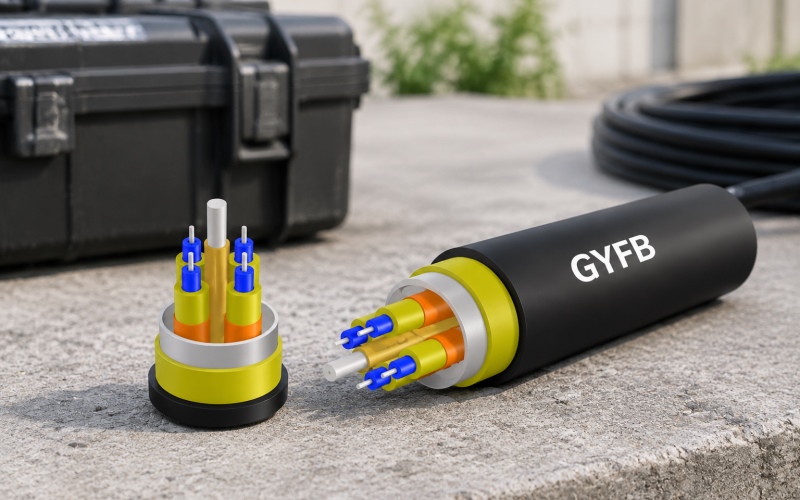
Field technicians frequently route communication cables across temporary work areas, outdoor installations, and changing operating environments.During deployment, operators may need to pull cables over different surfaces, position them around equipment, and retrieve them after the communication task is complete. Therefore, the cable structure must provide sufficient mechanical support while maintaining the flexibility required for practical handling. The GYFB design uses a central strength member and sub-unit construction to support the internal fiber elements during these operations.
Its six-core multimode fiber configuration provides optical connections for temporary communication and field networking applications. Meanwhile, the compact round structure, with an outer diameter of 8.5 ± 0.3 mm, makes transportation and cable arrangement more manageable. The loose tube diameter is 2.0 ± 0.1 mm, and the specified short-term bending radius is 20D. Consequently, installers can use these dimensions as references when planning cable routes and avoiding excessively tight bends.
How Does the TPU Jacket Improve Outdoor Durability?
The outer jacket is the first protective layer against many forms of mechanical and environmental exposure. Thermoplastic polyurethane, or TPU, offers flexibility and resistance to abrasion, oil, corrosion, and UV exposure, making it suitable for demanding outdoor cable applications. As a result, a tactical draggable fiber optic cable with a TPU jacket can better withstand routine surface contact during field deployment and retrieval. The material also shields the internal cable structure from environmental exposure, although users should confirm its suitability for the temperatures and substances present at the installation site.
Several structural features work together to support the cable’s handling performance:
- Flexible TPU jacket: Helps resist abrasion and exposure to oil, corrosion, and UV radiation.
- Central strength member: Provides structural reinforcement against pulling forces during deployment.
- Sub-unit fiber structure: Organizes the internal fiber elements within the cable.
- Compact round profile: Supports transportation, storage, and routing in temporary installations.
In addition, flexibility allows operators to route the cable around equipment and temporary structures more conveniently. However, a flexible jacket does not mean the cable can be twisted, sharply folded, or dragged over every surface without precautions. Instead, controlled pulling, suitable cable guides, and proper storage methods help reduce unnecessary stress during repeated use.
What Do the Tensile and Crush Resistance Ratings Mean?
Mechanical performance is especially important when cables are pulled over long distances or placed in areas where equipment and other materials may exert pressure. The GYFB 6 Core model specifies different short-term and long-term tensile and crush resistance values. These distinctions help engineers evaluate the cable under different loading conditions and plan appropriate deployment methods. The following table summarizes the mechanical and structural specifications provided for this model.
| Specification | Value |
|---|---|
| Fiber type | Multimode fiber |
| Fiber count | 6 cores |
| Cable structure | Sub-unit + central strength member + TPU jacket |
| Outer diameter | 8.5 ± 0.3 mm |
| Loose tube diameter | 2.0 ± 0.1 mm |
| Outer jacket material | TPU |
| Cable color | Black |
| Short-term tensile strength | 1000 N |
| Long-term tensile strength | 500 N |
| Short-term crush resistance | 1000 N/100 mm |
| Long-term crush resistance | 300 N/100 mm |
| Short-term bending radius | 20D |
A fiber optic cable tensile test evaluates how a cable responds to an applied pulling force under specified test conditions. For this model, the short-term tensile rating is 1000 N, while the long-term rating is 500 N. These values should be considered when selecting pulling equipment and planning cable installation, rather than treating the short-term rating as a continuous operating load. Similarly, a fiber optic cable crush test assesses resistance to compression over a defined contact length, helping engineers evaluate the cable’s ability to withstand pressure during handling and installation.
Where Is This Tactical Fiber Cable Commonly Used?
Temporary communication systems, outdoor broadcasting, emergency networks, and military field operations often require cables that can be deployed quickly and retrieved after use. In these situations, an outdoor fiber optic cable must combine suitable optical characteristics with a construction that supports practical field handling. The six-core multimode configuration provides multiple fiber channels within a compact cable structure, while the TPU jacket and central strength member contribute to mechanical protection. Actual transmission distance and bandwidth depend on the fiber grade, optical equipment, connectors, and overall link design.
The GYFB cable can also be considered for temporary networking installations where equipment locations or cable routes change frequently. Its black jacket and compact round profile support practical transportation and deployment, while the mechanical ratings provide useful information for project evaluation. Nevertheless, users should consider cable length, pulling method, connector protection, environmental exposure, and storage conditions before selecting the product. Proper cable reels and controlled retrieval procedures can further reduce the risk of damage between deployments.
How to Select a Custom Fiber Optic Cable Manufacturer
Different communication projects may require different fiber counts, cable lengths, jacket materials, or structural configurations. When evaluating a custom fiber optic cable manufacturer, buyers should review the fiber type, cable construction, mechanical ratings, and available test documentation. Furthermore, it is important to confirm whether the manufacturer can maintain consistent specifications and support the required cable assembly or connector configuration. These checks help ensure that the selected cable matches the actual deployment conditions.
YITOFC provides the GYFB 6 Core cable for applications that require a flexible TPU jacket and reinforced cable structure. Its six-core multimode configuration, tensile ratings, and crush resistance specifications provide a technical basis for evaluating its suitability for outdoor communication projects. Before ordering, project teams should confirm the required optical performance, cable length, environmental conditions, and testing requirements. Ultimately, a tactical draggable fiber optic cable can support repeated deployment and retrieval when its mechanical characteristics, installation methods, and operating conditions are properly matched.
Conclusion
Repeated deployment places continuous demands on a fiber cable’s jacket, internal structure, and mechanical strength. The GYFB 6 Core design addresses these requirements through a flexible TPU outer jacket, a central strength member, and a six-core multimode fiber configuration. In addition, its specified tensile and crush resistance values help engineers assess its suitability for temporary communication and outdoor networking applications. With appropriate cable handling, installation planning, and storage procedures, this construction can support reliable field connectivity across repeated deployment cycles.