












Outdoor fiber optic networks require cables that can maintain stable signal transmission despite moisture, temperature changes, compression, and other environmental challenges. Therefore, cable construction plays an important role in protecting optical fibers and supporting long-term network performance. A GYXTW steel tape armored cable combines a central loose tube, corrugated steel tape armor, and a UV-resistant polyethylene outer jacket to provide mechanical protection for outdoor communication systems. Its unitube structure also helps organize and protect the optical fibers within a compact cable design.
How Does the Central Loose Tube Structure Protect Optical Fibers?
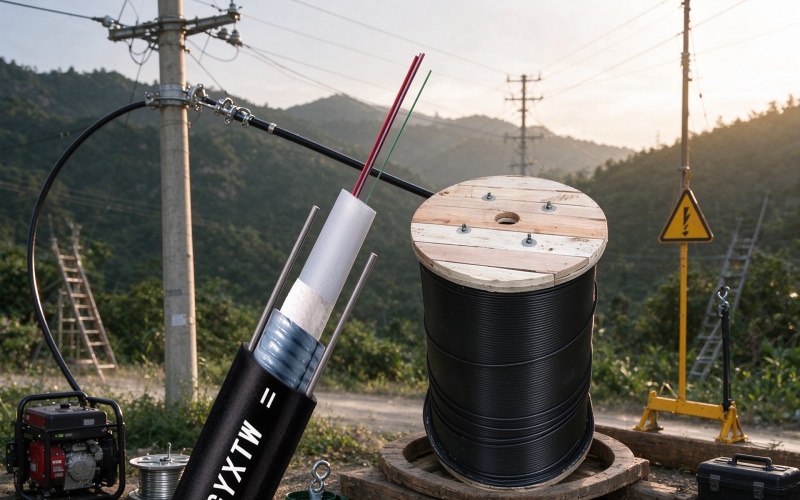
The central loose tube is one of the defining features of GYXTW cable. Optical fibers sit inside a central tube filled with water-blocking gel, which helps prevent moisture from reaching the fibers. Meanwhile, the loose tube provides space for the fibers and helps reduce the direct impact of external mechanical stress. As a result, this central loose tube fiber optic cable design supports outdoor applications where moisture protection and stable fiber positioning are important.
The water-blocking gel also helps limit water movement along the tube if moisture enters the cable structure. This feature is particularly useful in outdoor installations where cables may encounter rainwater or damp ground conditions. However, cable joints and termination points also require proper sealing to maintain the overall water protection of the network. By combining the central tube with suitable installation practices, network contractors can improve the reliability of outdoor fiber routes.
Why Does Corrugated Steel Tape Armor Matter?
Mechanical protection is another important consideration for outdoor fiber optic cables. The GYXTW structure uses corrugated steel tape armor around the central loose tube, providing an additional protective layer against external pressure and physical damage. Furthermore, the corrugated design contributes to mechanical strength while maintaining a practical construction for outdoor deployment. This makes the steel tape armored fiber optic cable suitable for projects that require more protection than an unarmored cable can provide.
The cable also incorporates two parallel steel wires as strength members. These wires reinforce the cable structure and help support tensile performance during installation and operation. Meanwhile, the black polyethylene outer jacket provides protection against outdoor exposure, including ultraviolet radiation. Together, the steel tape armor, strength members, and PE jacket create a layered construction that supports dependable cable performance in demanding installation environments.
The main structural features contribute to cable protection in different ways:
- Central loose tube: Holds the optical fibers and contains water-blocking gel to help prevent moisture penetration.
- Corrugated steel tape: Adds mechanical protection against external pressure and physical damage.
- Two parallel steel wires: Reinforce the cable and support tensile strength during deployment.
- UV-resistant PE jacket: Protects the cable exterior against outdoor exposure and sunlight.
How Does the Cable Structure Support Stable Signal Transmission?
Optical signal stability depends on more than the fiber itself. External pressure, excessive bending, moisture, and installation-related stress can affect fiber performance if the cable lacks suitable protection. A GYXTW steel tape armored cable addresses these concerns through its central loose tube, water-blocking gel, steel tape armor, and reinforced construction. These features help protect the optical fibers from common outdoor installation risks and support consistent signal transmission.
The cable supports several single-mode fiber options, including G652D, G655, G657A1, and G657A2. These fiber types allow network planners to select an appropriate option according to transmission distance, routing conditions, and project requirements. Fiber counts range from 2 to 24 cores, providing flexibility for different network capacities. Moreover, the specified operating temperature range of -40°C to +70°C makes the cable suitable for outdoor projects that experience substantial seasonal temperature changes.
GYXTW Cable Specifications and Installation Options
The GYXTW cable combines a unitube construction with steel tape armor and two parallel steel wires. Its available fiber counts and fiber types support different network requirements, while its outer jacket helps protect the cable during outdoor service. The following table summarizes the supplied product specifications for easier technical evaluation.
| Specification | Details |
|---|---|
| Cable type | GYXTW uni-loose tube outdoor fiber optic cable |
| Fiber count | 2, 4, 6, 8, 12, 24 cores |
| Fiber type | Single mode |
| Fiber standards | G652D, G655, G657A1, G657A2 |
| Armor material | Corrugated steel tape |
| Strength member | Two parallel steel wires |
| Outer jacket | UV-resistant black PE |
| Installation methods | Aerial, duct, direct burial |
| Operating temperature | -40°C to +70°C |
| Main features | Waterproof, crush resistant, rodent resistant, low attenuation, high tensile strength |
| Standards and quality references | IEC, RoHS, ISO 9001 |
| OEM/ODM service | Supported |
The cable supports three main installation methods, allowing contractors to adapt deployment to different network layouts. Aerial installation suits overhead routes, while duct installation provides a protected pathway through underground infrastructure. Direct burial can also serve projects where the route design and site conditions permit this method. In each case, installers should follow suitable handling procedures and confirm the required installation specifications before deployment.
Where Is GYXTW Outdoor Fiber Optic Cable Commonly Used?
A GYXTW steel tape armored cable can support outdoor telecom infrastructure, broadband networks, and other optical communication projects that require mechanical reinforcement. Its central loose tube construction helps protect the fibers, while the steel tape armor and PE jacket provide additional protection against environmental and physical stress. Furthermore, the available 2-to-24-core configurations allow network planners to select a fiber count according to the required connection capacity. This flexibility makes the design suitable for different outdoor network layouts.
As a GYXTW outdoor fiber optic cable, it can be considered for aerial, duct, and direct burial routes. However, the final selection should account for installation conditions, environmental exposure, route length, and network capacity. Contractors should also check the required fiber type and confirm compatibility with the optical equipment used in the project. These steps help ensure that the cable construction matches the actual requirements of the communication network.
Choosing a Reliable GYXTW Cable Manufacturer
When selecting an outdoor fiber optic cable, buyers should evaluate more than the fiber count or purchase price. Cable structure, fiber type, armor material, installation method, and quality documentation all influence whether a product suits a particular project. In addition, consistent manufacturing and clear technical specifications help contractors plan installation and maintenance more effectively. Working with an experienced supplier can therefore simplify product evaluation and project coordination.
YITOFC provides GYXTW cable options with 2 to 24 single-mode fiber cores and supports OEM and ODM services. Customers can discuss fiber configurations, cable markings, packaging, and other project requirements when planning their orders. The supplied product information also identifies IEC, RoHS, and ISO 9001 among its standards and quality references. By matching cable construction with the installation environment and network design, project teams can select a suitable solution for dependable outdoor optical communication.