










As fiber broadband continues to expand into homes, apartments, offices, and commercial buildings, indoor cable safety has become an increasingly important consideration. Unlike outdoor networks, indoor FTTH cables are installed in enclosed spaces where smoke and toxic gases can create additional risks during a fire. Therefore, cable jacket materials deserve careful attention during network planning. An LSOH sheathed flat drop cable combines a compact flat structure with low-smoke and halogen-free characteristics, making it suitable for residential and indoor fiber optic installations.
Why LSZH Materials Matter Indoors
Cable jackets can release smoke and gases when exposed to high temperatures or fire. In enclosed residential and commercial environments, excessive smoke can reduce visibility and make evacuation more difficult. Furthermore, halogen-containing materials may produce corrosive gases during combustion. For this reason, Low Smoke Zero Halogen, commonly known as LSZH, has become an important material option for indoor communication cables. The LSZH jacket used on the GJXH/GJXFH FTTH drop cable is designed to provide flame-retardant performance while producing low smoke and zero halogen emissions. Consequently, it offers an additional safety consideration for indoor broadband infrastructure.
How a Flat Structure Simplifies Installation
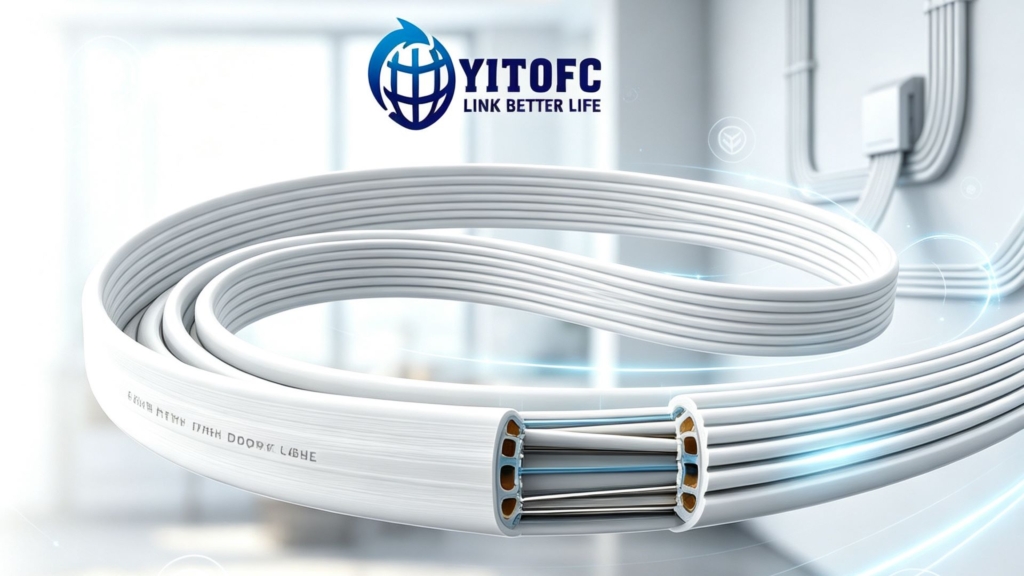
Indoor fiber installations often require cables to pass through narrow spaces, corners, walls, and building entry points. A bulky cable structure can make routing more difficult and may require additional installation space. In contrast, a flat drop cable has a compact profile that can simplify cable routing in residential and commercial environments. The GJXH/GJXFH cable uses a lightweight flat structure that is designed for practical indoor deployment. Moreover, its compact shape can make it easier to position along walls, ceilings, and other building surfaces. As a result, installers can achieve a cleaner and more efficient fiber routing arrangement.
Bend-Insensitive Fiber for Reliable Indoor Routing
Indoor FTTH cables frequently encounter bends during installation. Tight routing around corners or through limited spaces can potentially affect optical performance if the fiber is not designed for bending conditions. Therefore, the choice of optical fiber is particularly important for indoor drop cables.
This cable uses G.657A1 or G.657A2 bend-insensitive single-mode fiber, which is designed to provide improved bending performance. Furthermore, the fiber supports low transmission loss and stable optical communication. Consequently, the cable can maintain reliable network performance while accommodating practical indoor routing requirements.
Key Safety and Installation Benefits
The combination of LSZH material, bend-insensitive fiber, and reinforced construction provides several advantages for indoor FTTH deployment:
- Low smoke performance: Helps reduce smoke generation compared with conventional jacket materials during fire conditions.
- Zero halogen emissions: Helps reduce the risk of corrosive halogen gases during combustion.
- Flame-retardant jacket: Adds an important safety characteristic for indoor cable installations.
- Flat and lightweight structure: Simplifies routing in limited installation spaces.
- Bend-insensitive fiber: Supports reliable optical performance around common indoor bends.
- Steel reinforcement: Improves tensile strength and crush resistance.
- Multiple core options: Provides flexibility for different broadband network configurations.
Reinforced Construction for Better Mechanical Protection
Indoor cables still need sufficient mechanical strength during installation and operation. Pulling, bending, or accidental pressure can place stress on the cable. Therefore, a lightweight design should not compromise basic mechanical protection. The GJXH/GJXFH cable incorporates two parallel steel wires as reinforcement. These strength members improve tensile performance and crush resistance while maintaining the cable’s flat structure. As a result, the cable can provide a practical balance between mechanical protection and installation convenience.
Low Smoke Design for Residential Environments
Residential buildings contain many enclosed areas where cables may run through walls, ceilings, corridors, and equipment spaces. In these locations, smoke behavior can become an important consideration when selecting cable materials. An LSOH sheathed flat drop cable uses an LSZH jacket designed to limit smoke generation and avoid halogen emissions. Therefore, it can be considered for indoor FTTH installations where material safety is an important part of the network design. This characteristic is particularly relevant for homes, apartments, offices, and commercial buildings.
Suitable for Broadband and Telecom Infrastructure
Indoor FTTH cables serve as the final connection between the optical distribution network and end-user locations. They may also be used in building cabling systems and telecom infrastructure. Therefore, the cable needs to combine optical reliability, mechanical strength, and practical installation characteristics. The GJXH/GJXFH cable supports 1, 2, and 4 core configurations, allowing network designers to select a suitable structure for different connection requirements. Moreover, the single-mode fiber design supports broadband access applications. Consequently, the cable can be integrated into a wide range of indoor fiber network projects.
Product Specifications at a Glance
| Feature | Specification | Application Benefit |
|---|---|---|
| Cable Type | GJXH / GJXFH | Indoor FTTH deployment |
| Fiber Type | G.657A1 / G.657A2 | Improved bend performance |
| Fiber Mode | Single-Mode | Stable optical transmission |
| Core Options | 1 / 2 / 4 Core | Flexible network configurations |
| Cable Structure | Flat | Easier indoor routing |
| Strength Members | 2 Parallel Steel Wires | Improved tensile and crush resistance |
| Jacket | LSZH | Low smoke and zero halogen |
| Flame Performance | Flame Retardant | Supports indoor safety |
| Main Applications | FTTH / Building Cabling / Telecom | Residential and commercial networks |
| Customization | OEM Available | Supports project-specific requirements |
Why Low Smoke and Halogen-Free Design Matters
The importance of LSZH materials goes beyond basic cable construction. In the event of fire, reducing smoke and avoiding halogen emissions can help address specific safety concerns associated with indoor communication infrastructure. Furthermore, LSZH jackets can be appropriate for environments where people and sensitive equipment are located close to communication cables. Therefore, selecting a low-smoke and halogen-free cable can contribute to a more safety-conscious indoor network design.
Flexible Configurations for Different Projects
Every building has different cabling requirements. Residential apartments may require compact routing, while office buildings can involve larger structured cabling systems. Consequently, cable manufacturers need to provide flexible configurations for different installation scenarios. With 1, 2, and 4 core options, this drop cable can accommodate different fiber connection requirements. In addition, OEM and customized production allow specifications to be adjusted according to project conditions. Yitong Fiber Optic Cable provides indoor FTTH cable solutions designed to support different network deployment requirements.
Balancing Safety, Performance, and Installation Efficiency
An indoor FTTH cable needs to satisfy several requirements at the same time. It should provide stable optical transmission, sufficient mechanical strength, practical installation characteristics, and suitable jacket performance. Therefore, focusing on only one specification may not provide the best overall solution.
The combination of G.657A1 or G.657A2 fiber, parallel steel reinforcement, and an LSZH flat jacket creates a balanced cable design. Moreover, the flat structure helps simplify routing while the reinforced construction provides mechanical support. As a result, the cable can meet the practical needs of many residential and commercial installations.
Applications in Modern Indoor Fiber Networks
An LSOH sheathed flat drop cable is suitable for various indoor fiber applications where low-smoke and halogen-free properties are valued. Residential broadband is a key application, especially in apartments and houses where cables may run through enclosed building spaces. In addition, the cable can be used for office networks, building cabling, telecom infrastructure, and other indoor FTTH projects. Its compact structure and multiple core configurations provide flexibility for different deployment conditions. Therefore, network installers can select an appropriate configuration based on the building layout and connection requirements.
Conclusion
Indoor fiber optic networks require more than reliable optical transmission. Cable safety, mechanical protection, installation flexibility, and material selection can all influence the suitability of an FTTH drop cable. For residential and commercial environments, low-smoke and halogen-free jacket materials can provide an important advantage when safety is a key consideration.
Ultimately, an LSOH sheathed flat drop cable combines an LSZH flame-retardant jacket, bend-insensitive single-mode fiber, parallel steel reinforcement, and a compact flat structure. With 1, 2, and 4 core options plus OEM customization, the GJXH/GJXFH cable provides a practical solution for indoor FTTH, broadband access, building cabling, and telecom infrastructure applications.