








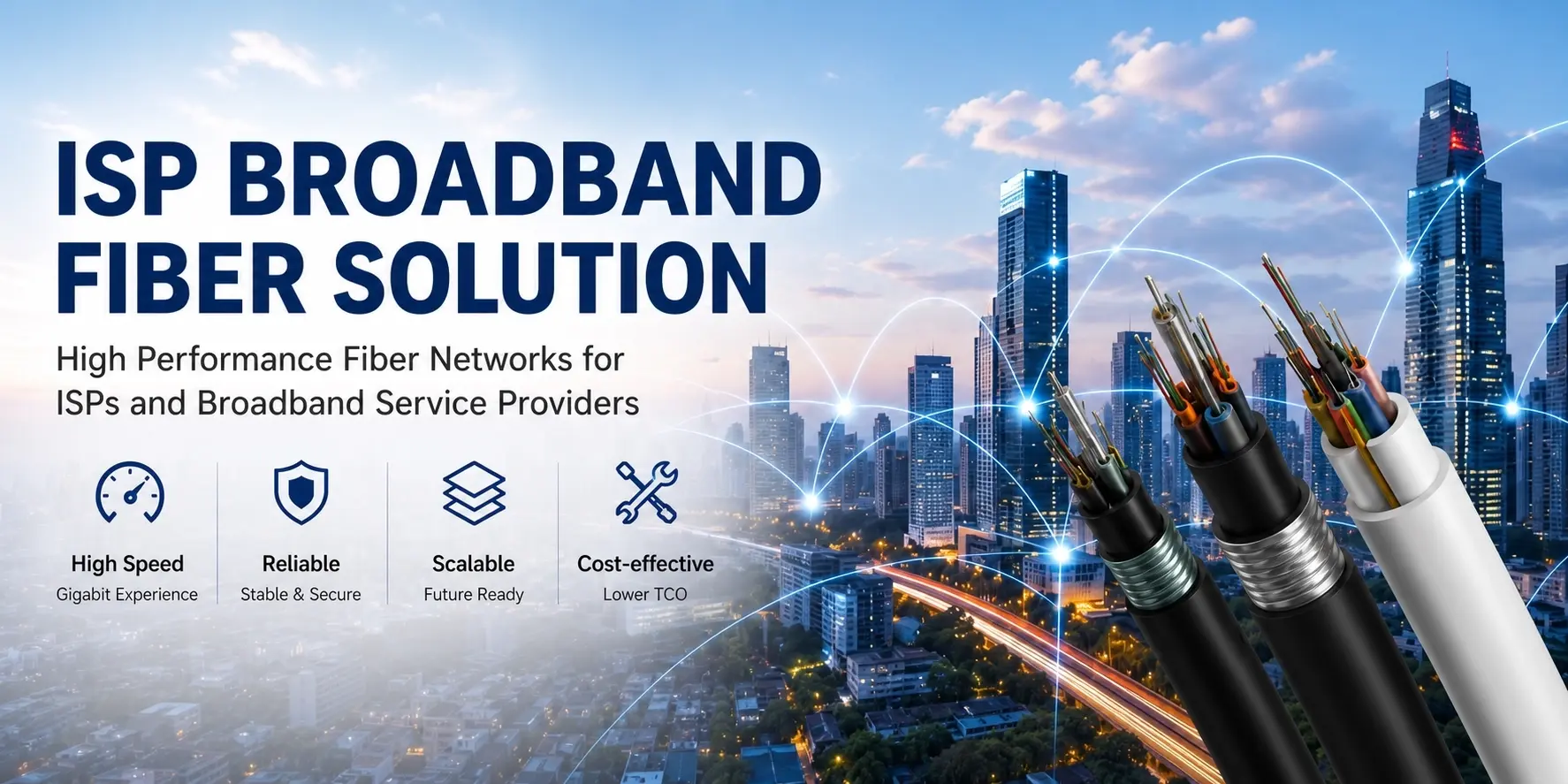
As broadband networks continue to expand, fiber optic cables play an increasingly important role in delivering stable and high-speed connections to homes and businesses. However, last-mile installations often involve tight bends, narrow spaces, and complicated routing paths. Therefore, choosing a suitable cable can directly affect optical performance and network reliability. A bend insensitive ftth drop cable is designed to maintain stable signal transmission even when the cable experiences tighter bending conditions, making it a practical option for modern FTTH access networks.
Why Low Signal Attenuation Matters
Signal attenuation refers to the reduction of optical power as light travels through a fiber. When attenuation becomes too high, the available signal strength at the receiving end can decrease. As a result, network performance may become less stable, particularly across longer connections or installations with multiple connection points.
For FTTH networks, maintaining low attenuation is especially important because the drop cable forms part of the final connection between the distribution network and the end user. Furthermore, stable optical performance can help network operators maintain consistent broadband quality. Therefore, cable construction and fiber selection should be carefully considered during FTTH deployment.
How Bend-Insensitive Fiber Improves FTTH Installation
Traditional optical fibers can experience increased optical loss when bent beyond their recommended radius. This can create challenges when installers need to route cables around corners, through conduits, or into compact indoor spaces. In contrast, bend-insensitive fiber is designed to reduce additional signal loss caused by bending. The GJYXCH outdoor fiber optic drop cable uses G.657A1 or G.657A2 bend-insensitive single-mode fiber. Consequently, the cable can provide improved bending performance while maintaining reliable optical transmission. This characteristic is particularly useful for last-mile connections where installation flexibility is important.
Benefits of Bend-Insensitive FTTH Drop Cables
A bend-insensitive design can provide several practical advantages for broadband deployment:
- Lower bending-related attenuation: Helps reduce optical signal loss when the cable follows curved installation paths.
- Improved installation flexibility: Supports routing through narrow spaces and around corners.
- Stable single-mode transmission: Suitable for high-speed FTTH access networks.
- Reduced installation concerns: Provides greater tolerance for common last-mile routing conditions.
- Long-term network reliability: Helps maintain consistent optical performance when installed correctly.
- Multiple core options: 1, 2, and 4 core configurations support different network requirements.
G.657A1 and G.657A2 Fiber Options
Fiber type has a direct influence on bending performance. G.657A1 and G.657A2 are bend-insensitive single-mode fiber categories designed for applications where cable routing may involve tighter bends. In addition, these fiber types can be integrated into FTTH drop cable designs without changing the fundamental single-mode transmission architecture. Therefore, network designers can select an appropriate fiber configuration based on installation conditions, optical requirements, and project specifications.
Outdoor Construction for Reliable FTTH Deployment
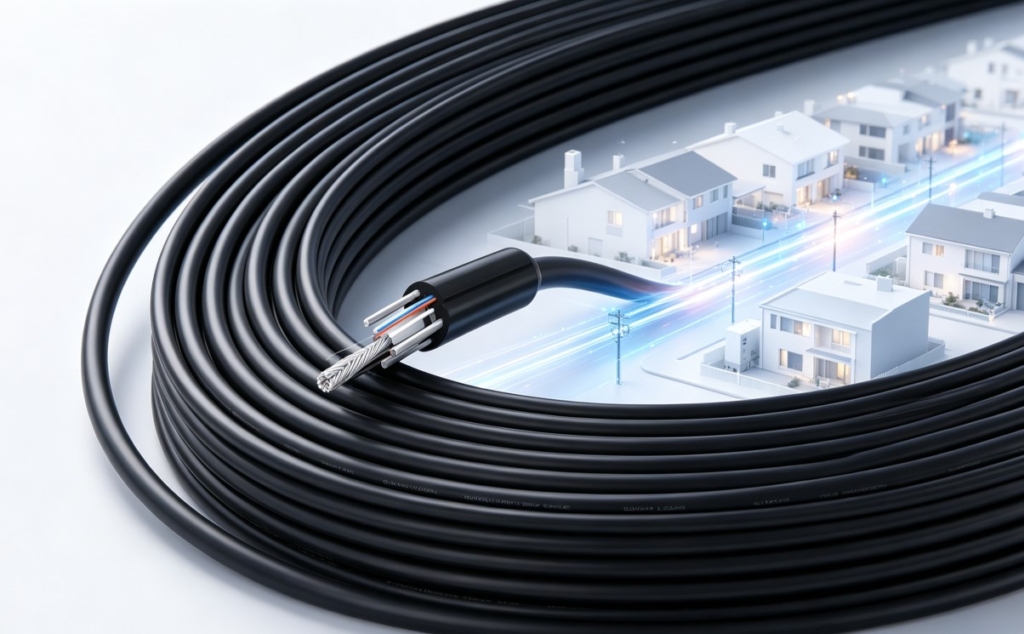
FTTH networks are not always installed in protected indoor environments. Outdoor sections can expose cables to sunlight, moisture, temperature changes, and mechanical stress. Consequently, the outer cable construction needs to provide appropriate environmental protection. The GJYXCH cable uses a durable LSZH jacket designed to provide weather resistance, UV protection, and flame-retardant performance. Furthermore, parallel steel wire strength members improve tensile strength and mechanical protection. These features help the cable withstand common installation and outdoor operating conditions.
Aerial Installation with Optional Messenger Wire
Some FTTH projects require aerial deployment rather than underground or fully enclosed routing. For these applications, the cable can be configured with an optional steel messenger wire. This additional support structure can help simplify aerial installation while providing mechanical support.
As a result, the same general cable platform can accommodate different deployment environments. Whether used in residential broadband connections or telecom infrastructure, selecting the appropriate support configuration can improve installation practicality.
Cable Specifications at a Glance
| Feature | Specification | Practical Benefit |
|---|---|---|
| Cable Type | GJYXCH Outdoor Drop Cable | Designed for FTTH access networks |
| Fiber Type | G.657A1 / G.657A2 | Improved bending performance |
| Fiber Mode | Single-Mode | Supports broadband optical transmission |
| Core Options | 1 / 2 / 4 Core | Fits different network requirements |
| Strength Member | Parallel Steel Wire | Improves tensile strength |
| Messenger Wire | Optional Steel Wire | Supports aerial installation |
| Jacket | LSZH | Provides environmental protection |
| UV Protection | Yes | Supports outdoor deployment |
| Flame Retardancy | Yes | Adds cable safety performance |
| Main Applications | FTTH / Telecom / ISP | Suitable for last-mile networks |
Why Cable Construction Affects Signal Stability
Optical performance depends not only on the fiber itself but also on the way the cable is constructed and installed. Mechanical stress, excessive bending, and environmental exposure can all affect long-term cable performance. Therefore, a well-designed drop cable needs to balance optical characteristics with mechanical protection. The combination of bend-insensitive fiber and steel strength members provides this balance. The fiber helps maintain optical performance during bending, while the strength members provide mechanical support. Consequently, the cable can offer a practical combination of flexibility and protection for demanding FTTH installations.
Applications in Modern Broadband Networks
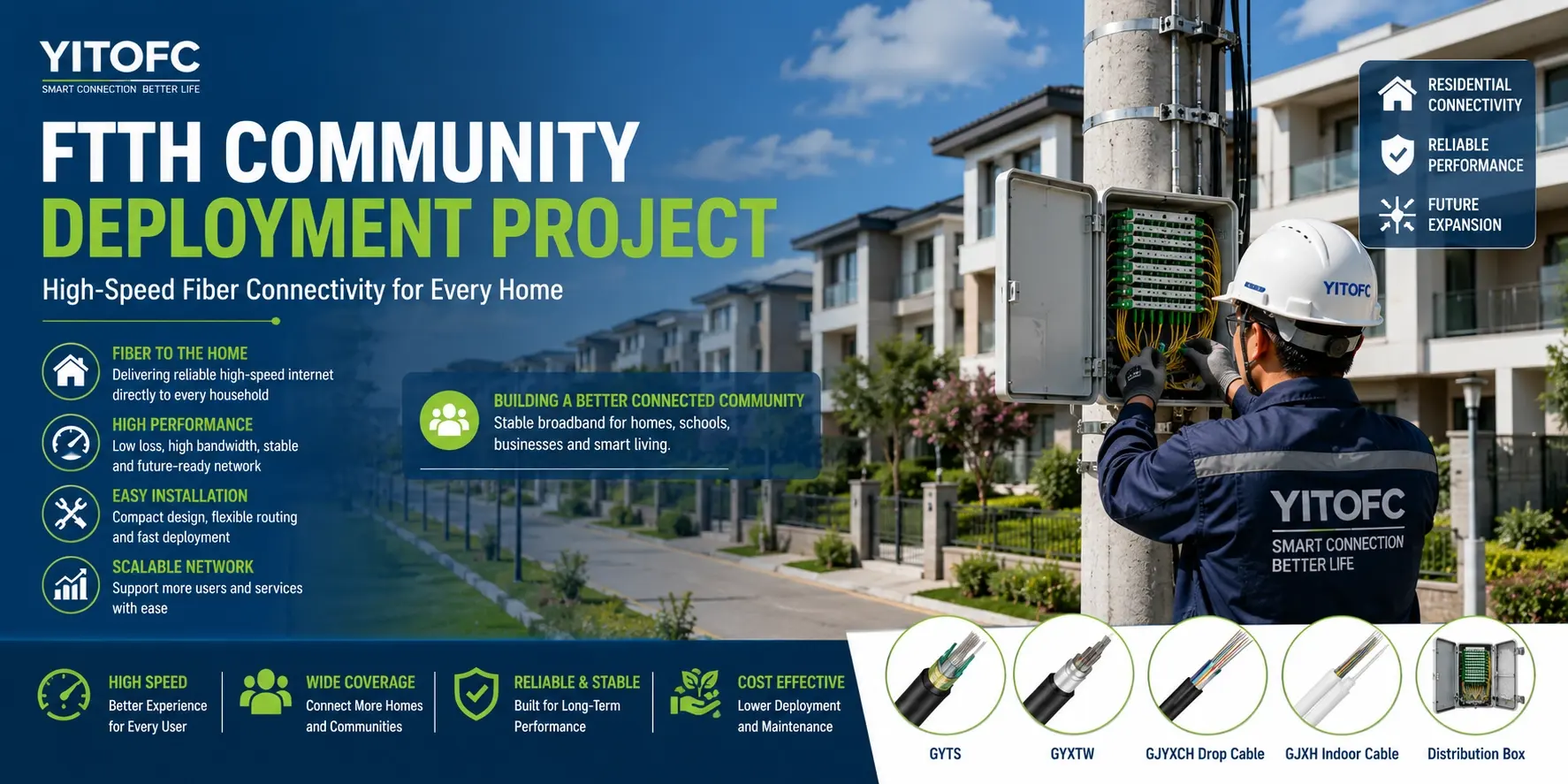
A bend insensitive ftth drop cable can be used across several last-mile broadband scenarios. Residential broadband connections are one of the most common applications because installers often need to route cables through walls, narrow passages, and building entry points. Moreover, the cable can support telecom networks, ISP infrastructure, and larger FTTH deployment projects. The availability of 1, 2, and 4 core configurations allows network planners to select a suitable structure based on connection requirements. Therefore, the cable can adapt to different network architectures and installation environments.
Custom Options for Different Network Requirements
Every fiber deployment has its own installation conditions and technical requirements. For this reason, cable specifications may need to be adjusted according to the project. Core count, fiber type, messenger configuration, and other construction details can be selected according to application requirements. Yitong Fiber Optic Cable provides FTTH drop cable solutions for different network applications and supports OEM and customized specifications. Furthermore, customized configurations allow network operators and project integrators to select cable structures that better match their installation environments.
Improving Installation Efficiency and Network Reliability
Installation efficiency is another important consideration for FTTH projects. A cable that can tolerate tighter bends can provide installers with greater flexibility when routing through complex building structures. As a result, installation teams may have more options when working around corners or through limited spaces. At the same time, maintaining low optical attenuation helps protect transmission performance after installation. Therefore, combining bend-insensitive fiber with appropriate mechanical construction can contribute to a more reliable last-mile connection.
Choosing the Right Drop Cable for High-Speed Broadband
When selecting an FTTH drop cable, network operators should consider more than basic fiber specifications. Bending performance, attenuation, mechanical strength, environmental protection, core configuration, and installation method can all influence the final result. A bend insensitive ftth drop cable addresses several of these requirements through bend-insensitive single-mode fiber, protective cable construction, and flexible configuration options. Furthermore, G.657A1 and G.657A2 fiber choices provide additional flexibility for projects with different bending and routing conditions.
Conclusion
High-speed broadband networks depend on stable optical connections from the central network to the end user. Because FTTH drop cables are often installed through tight spaces and complex routes, bending performance can have a significant effect on signal quality. Low signal attenuation is therefore an important consideration when designing and deploying last-mile fiber networks.
Ultimately, a bend insensitive ftth drop cable can provide a useful combination of optical stability, installation flexibility, and outdoor protection. With G.657A1 or G.657A2 fiber, steel strength members, optional messenger wire, and an LSZH jacket, the GJYXCH cable is well suited to residential broadband, telecom networks, ISP projects, and modern FTTH infrastructure.