







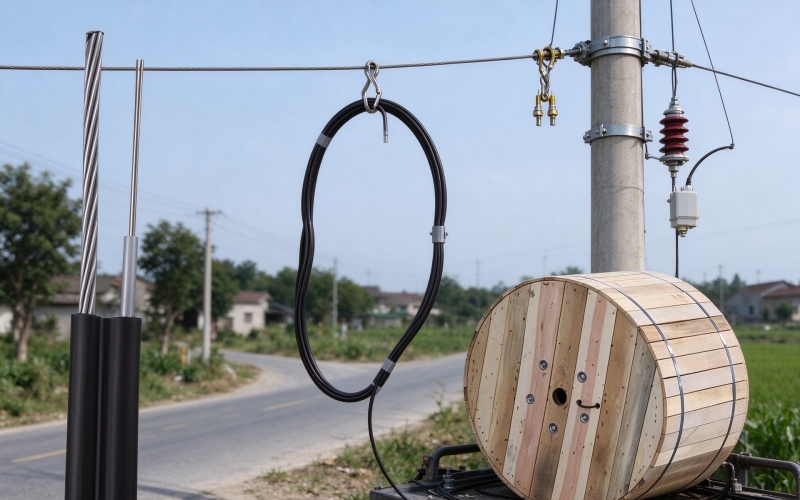
An outdoor figure 8 aerial fiber cable is a self-supporting optical cable designed for overhead installation in outdoor communication networks. Its figure 8 structure integrates an optical cable unit with a steel wire messenger, allowing the messenger to provide mechanical support during aerial deployment. As a result, installers can attach the cable to poles without installing a separate supporting wire along the route. This structure makes it a practical option for FTTH access networks, telecom distribution systems, and other overhead fiber communication projects.
The GYXTC8Y 4-core single-mode cable uses a central loose tube structure to protect its optical fibers. The tube contains a water-blocking compound, which helps reduce the risk of moisture entering the fiber unit. Meanwhile, the integrated steel wire messenger provides tensile support, while the PE outer jacket protects the cable in outdoor environments.
How Does an Integrated Steel Wire Messenger Reduce Installation Costs?
The integrated steel wire messenger is one of the main design features of figure 8 aerial cable. In a conventional installation that requires a separate support wire, contractors may need additional materials, installation steps, and labor to prepare the supporting structure. By combining the messenger and optical cable into one assembly, the figure 8 design can simplify overhead deployment and reduce the number of separate components required.
This integrated structure can help lower installation costs in several ways:
- Fewer separate components: The steel wire messenger is integrated into the cable structure, reducing the need to source and handle an additional support wire.
- Simplified installation: Installers can deploy the optical cable and its supporting member as one assembly, helping streamline pole installation.
- Reduced labor requirements: Fewer separate installation operations may shorten deployment time, depending on route conditions and project methods.
- Convenient cable handling: The figure 8 shape keeps the optical unit and messenger together, making the cable easier to identify and manage during installation.
- Suitable for overhead routes: The self-supporting design is useful for outdoor access networks where aerial installation is preferred.
However, actual cost savings depend on pole spacing, route length, installation equipment, local regulations, and labor costs. Therefore, project teams should evaluate the complete installation plan rather than comparing cable prices alone.
Key Cable Structure and Technical Specifications
The GYXTC8Y cable combines a central loose tube, a steel wire strength member, and a PE jacket. Each component serves a different purpose, helping the cable meet the mechanical and environmental requirements of outdoor aerial applications. In addition, the single-mode fiber configuration supports optical communication in FTTH and telecom access networks.
| Specification | Product Details |
|---|---|
| Cable Model | GYXTC8Y |
| Cable Type | Outdoor Aerial Self-Supporting Cable |
| Fiber Type | Single Mode Fiber (SM) |
| Fiber Count | 4 Fibers |
| Cable Structure | Central Loose Tube + Steel Wire Strength Member + PE Jacket |
| Loose Tube Material | PBT |
| Filling Material | Water Blocking Compound |
| Strength Member | Steel Wire Messenger |
| Outer Jacket Material | PE |
| Cable Shape | Figure 8 Structure |
| Installation Method | Aerial / Pole Installation |
| Operating Temperature | -40°C to +70°C |
| Application Environment | Outdoor |
The central loose tube helps protect the optical fibers, while the water-blocking compound provides additional protection against moisture penetration. Furthermore, the steel wire messenger supports the cable during overhead installation, and the PE jacket helps protect it from outdoor environmental exposure.
Why Is the Figure 8 Structure Suitable for FTTH Networks?
FTTH projects often require fiber routes between distribution points, poles, and end-user locations. Consequently, cable design can affect installation procedures, material requirements, and long-term network maintenance. A self-supporting structure can simplify aerial deployment because the messenger is already integrated into the cable assembly.
An outdoor figure 8 aerial fiber cable is therefore suitable for outdoor access networks that use pole-based installation. Its 4-core single-mode fiber configuration provides an option for communication links where the specified fiber count meets the project requirements. In addition, its compact structure and PE jacket make it suitable for outdoor telecom distribution applications.
For projects involving different fiber capacities or installation conditions, buyers should confirm the required fiber count, span length, tensile loading, and environmental specifications before selecting a cable. These details help ensure that the selected design matches the actual network requirements.
What Should Buyers Consider When Selecting an Aerial Fiber Cable Manufacturer?
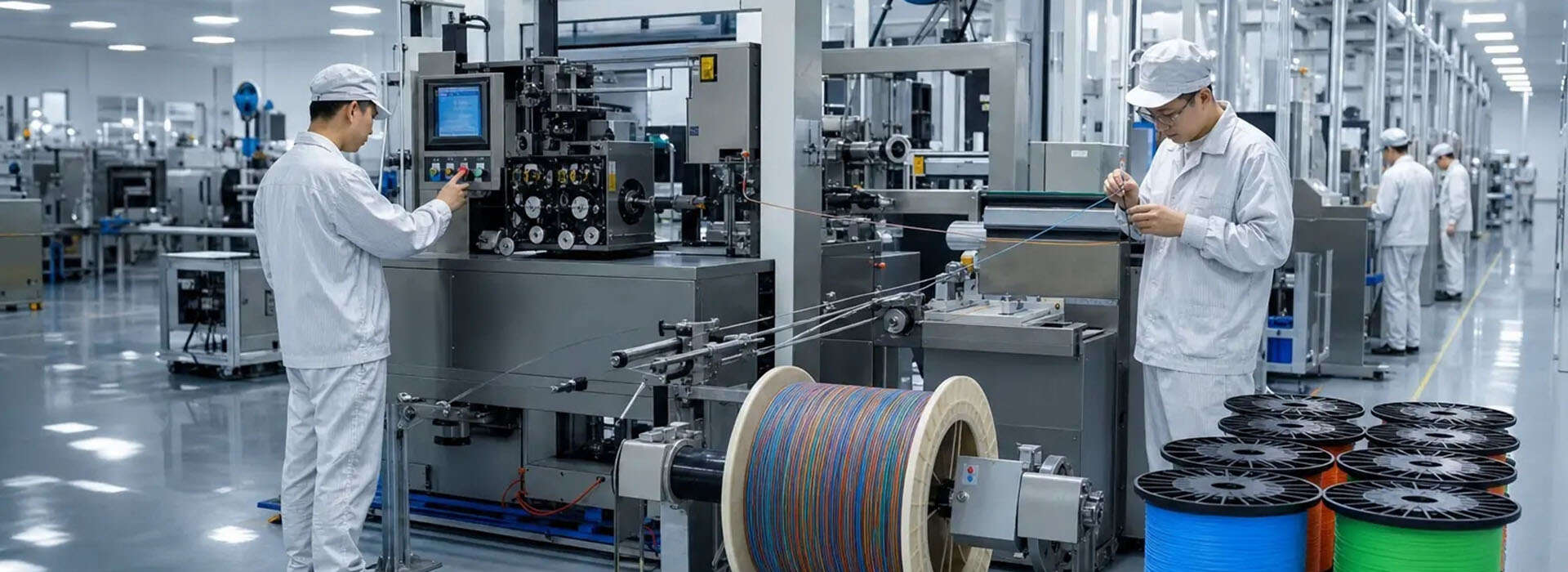
Choosing an aerial fiber optic cable manufacturer involves more than checking the product price. Buyers should review cable structure, messenger design, fiber configuration, material quality, and manufacturing consistency. They should also confirm whether the manufacturer can provide technical documentation and product options that match the project’s installation conditions.
When sourcing from an outdoor fiber optic cable manufacturer, it is important to check the PE jacket, loose tube protection, and water-blocking design. A qualified fiber optic cable factory should also be able to explain its production process and quality inspection procedures. For FTTH projects, buyers may compare a figure 8 design with a self-supporting FTTH drop cable according to the required route, fiber capacity, and installation method.
GYXTW fiber optic cable is another cable type buyers may encounter when comparing outdoor network products. However, its construction and installation requirements differ from those of a figure 8 self-supporting cable. Therefore, selection should be based on the actual project design rather than assuming that different outdoor cable types are interchangeable. YITOFC provides outdoor fiber optic cable options for communication and FTTH applications. Buyers can discuss fiber count, cable structure, and project requirements with the team to identify a suitable configuration for their network.
Supporting Cost-Effective Outdoor Fiber Deployment
An outdoor figure 8 aerial fiber cable integrates an optical cable unit and a steel wire messenger into one structure. This design can reduce the need for separate supporting components and simplify certain aerial installation procedures. At the same time, its central loose tube, water-blocking compound, and PE jacket help protect the optical fibers in outdoor applications.
For telecom contractors, network operators, and project buyers, the main considerations include installation conditions, fiber requirements, mechanical loading, and material quality. By reviewing these factors before procurement, buyers can select a cable configuration that meets their network needs while managing installation complexity and overall project costs.