













Modern power transmission networks require reliable grounding protection and communication systems. Traditional overhead ground wires help protect transmission lines against lightning and electrical faults. However, power utilities also need stable communication infrastructure to support voice, video, data transmission, and remote monitoring. OPGW technology combines these functions by integrating optical fibers into an overhead ground wire structure.
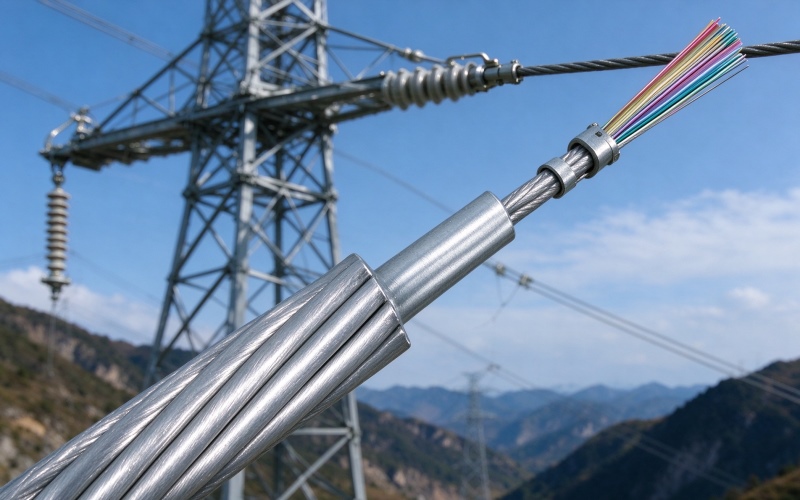
An OPGW optical ground wire cable is designed for installation on overhead power transmission towers. Its metallic structure typically uses aluminum-clad steel wires or aluminum alloy wires, while an internal optical fiber unit carries communication signals. Depending on project requirements, customers can select single-mode or multimode fiber and customize the fiber count. This integrated design supports both grounding protection and long-distance optical communication.
Why Are Lightning Resistance and Short Circuit Protection Important?
Overhead transmission lines are exposed to lightning strikes, electrical faults, wind, and other environmental stresses. Therefore, the ground wire must provide appropriate electrical protection while maintaining the mechanical integrity of the cable. OPGW uses a metallic wire structure to perform its grounding function, while the internal optical unit supports communication. Its electrical and mechanical performance should match the requirements of the transmission network.
Lightning resistance and short-circuit protection are important for several reasons:
- Grounding protection: The metallic structure provides a path for lightning and fault currents according to the electrical design of the transmission system.
- Optical fiber protection: The cable structure helps protect internal fibers from mechanical stress and external environmental conditions.
- Communication reliability: Protecting the optical unit helps maintain voice, video, and data transmission across power infrastructure.
- Network monitoring: Optical communication supports remote monitoring and information exchange between substations and control centers.
- Long-term operation: A suitable cable design helps meet the electrical, mechanical, and environmental demands of overhead installation.
In addition, protection performance depends on the cable structure, wire materials, dimensions, and specified fault-current requirements. For this reason, project engineers should evaluate these factors before selecting a cable configuration.
How Does OPGW Support Power Transmission Communication?
An OPGW optical ground wire cable combines grounding and optical communication functions within one overhead structure. Its integrated fibers can transmit communication signals over long distances, connecting substations, control centers, and monitoring equipment. Moreover, installing the cable along existing transmission tower routes can help integrate communication infrastructure with the power network. This makes OPGW a practical component of a power transmission communication solution.
As smart grid networks develop, utilities increasingly require reliable communication for operational monitoring and data exchange. OPGW can support electric power communication systems, overhead line monitoring, and other applications that depend on stable optical transmission. Furthermore, integrating optical fibers into the ground wire can reduce the need for a separate aerial communication cable along the same route, depending on the project design.
Key Technical Factors When Selecting OPGW Cable
Choosing an appropriate cable requires consideration of electrical performance, mechanical requirements, optical transmission needs, and installation conditions. Buyers should also confirm that the selected configuration meets the technical specifications of the transmission project. The following table summarizes the main product details and their practical relevance.
| Technical factor | Available specification | Project consideration |
|---|---|---|
| Cable type | Optical Ground Wire Cable | Combines grounding and optical communication functions |
| Application | Overhead power transmission lines | Designed for overhead tower installation |
| Fiber type | Single-mode / Multimode | Selected according to communication requirements |
| Fiber count | Customized | Determined by project requirements |
| Cable structure | Aluminum-clad steel wire / Aluminum alloy wire + optical fiber unit | Selected according to electrical and mechanical requirements |
| Operating temperature | -40°C to +70°C | Considered according to local environmental conditions |
| Protection features | Lightning resistance, short-circuit protection, mechanical protection | Supports overhead power network requirements |
| Transmission distance | Long-distance optical communication | Supports communication across transmission routes |
| Standards | IEC 60794, IEEE, ITU-T | Applicable requirements should be confirmed for each project |
When reviewing these specifications, project teams should pay particular attention to the required fault-current performance, mechanical loading, and fiber configuration. In addition, installation conditions and compatibility with existing transmission towers should be checked before procurement. These steps help ensure that the selected cable matches the actual engineering requirements.
What Should Buyers Look for in an OPGW Cable Manufacturer?
Selecting a supplier involves more than comparing product prices. An experienced outdoor fiber optic cable manufacturer should understand the requirements of overhead installation, optical transmission, and mechanical protection. Buyers should also review production quality control, available fiber configurations, customization capabilities, and technical documentation. These factors are especially relevant for power utilities and engineering contractors managing large infrastructure projects.
When evaluating a single-mode fiber optic cable manufacturer, customers should confirm the available fiber options and their compatibility with the communication system. Similarly, buyers sourcing from a fiber optic cable manufacturer in China should review the supplier’s production capabilities, quality inspection procedures, and experience with project-specific requirements. Aerial fiber optic cable manufacturer selection should also consider whether the supplier can provide suitable cable structures and technical support for overhead applications.
YITOFC provides OPGW fiber optic cable options for overhead power transmission lines, including customized fiber counts and single-mode or multimode fiber configurations. The company supports project requirements involving lightning resistance, short-circuit protection, and mechanical protection, alongside OEM customization and technical support.
Supporting Reliable Power Transmission Networks
An OPGW optical ground wire cable combines overhead grounding protection with optical communication in one integrated structure. Its lightning resistance, short-circuit protection, and mechanical protection are important considerations for transmission networks exposed to electrical and environmental stresses. At the same time, its optical fibers support long-distance communication and monitoring across power infrastructure.
For utilities, engineering contractors, and power network developers, selecting the right configuration requires careful review of fiber type, fiber count, cable structure, operating temperature, and applicable standards. By matching these factors with project requirements, buyers can make more informed procurement decisions. With appropriate product selection and installation planning, OPGW can support reliable communication and grounding functions in modern power transmission systems.