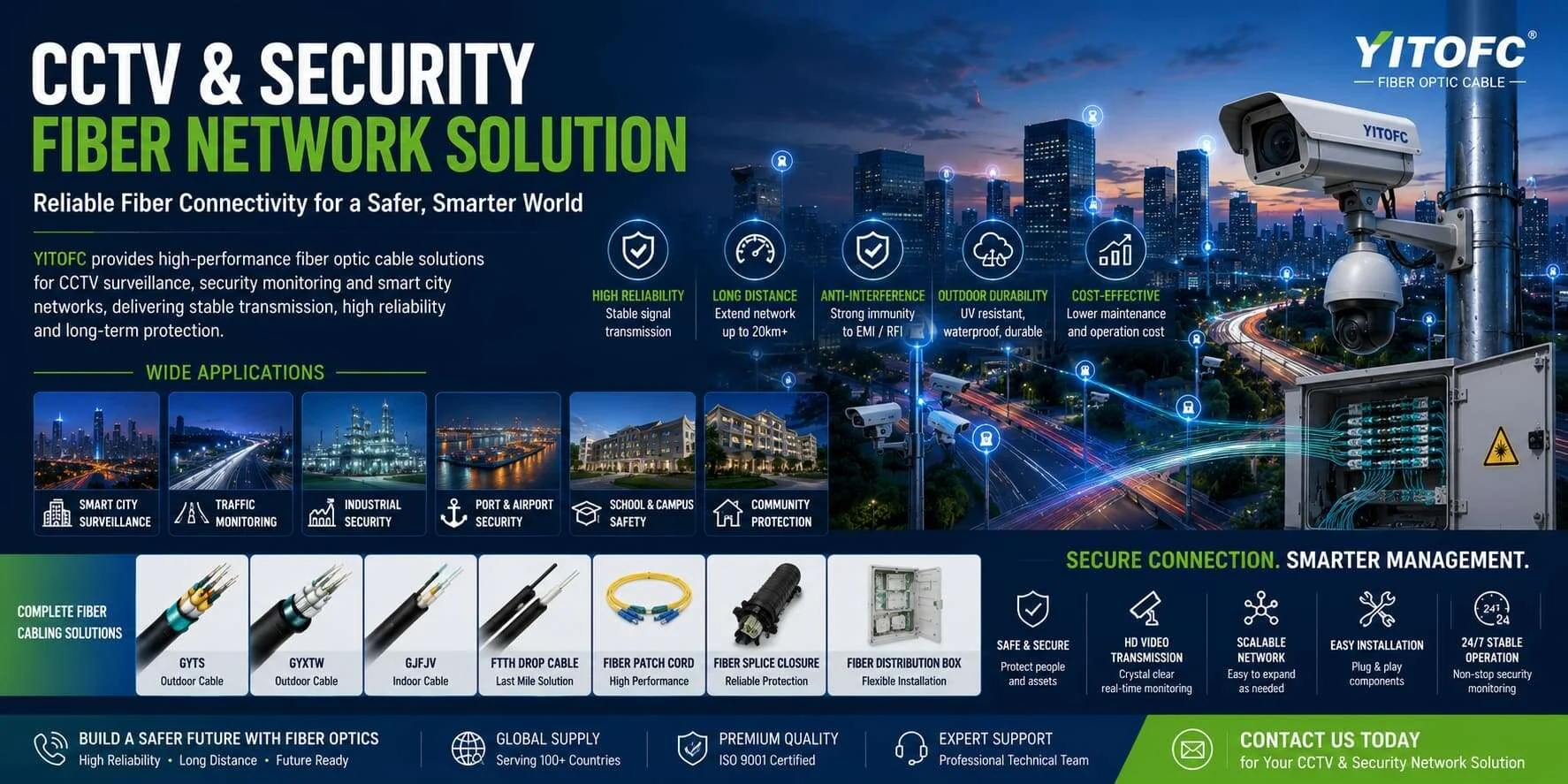












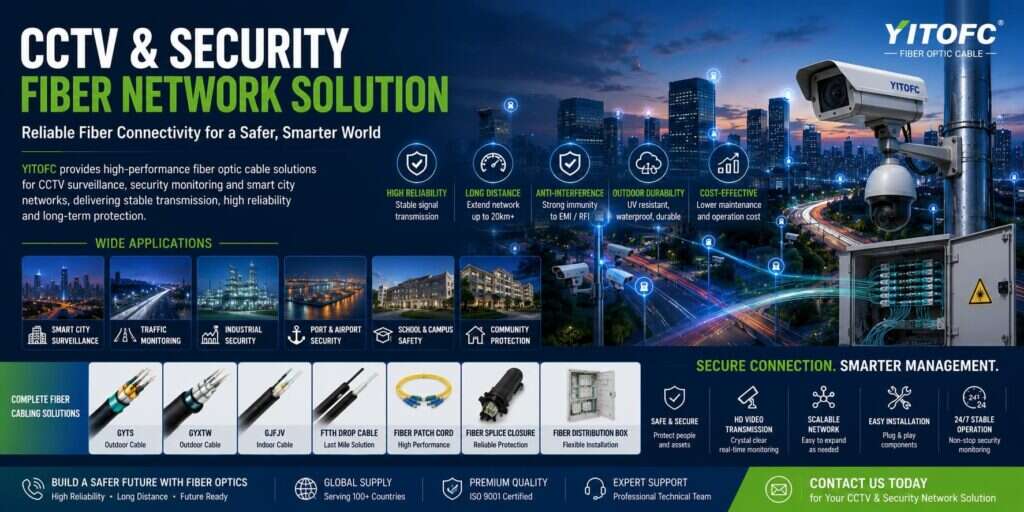
Modern CCTV and security systems depend on stable, high-bandwidth communication networks to transmit video, audio, control signals and monitoring data between cameras, control rooms, data centers and security platforms. The YITOFC CCTV & Security Fiber Network Solution provides dependable fiber optic cable options for city surveillance, industrial security, traffic monitoring, commercial buildings, campuses, airports, railways and other mission-critical monitoring applications.

Why Fiber Optic Cabling Is Important for CCTV Networks
Compared with traditional copper cabling, fiber optic networks support longer transmission distances, higher bandwidth and stronger resistance to electromagnetic interference. This makes fiber an ideal choice for high-resolution IP cameras, centralized monitoring systems and large-scale surveillance networks.
- Long-distance video transmission
- High bandwidth capacity for 4K and 8K IP cameras
- Low signal attenuation over extended routes
- Resistance to electromagnetic interference
- Improved transmission security
- Stable performance in industrial environments
- Support for future camera and sensor expansion
- Reduced maintenance requirements over long distances
Typical CCTV Fiber Network Architecture
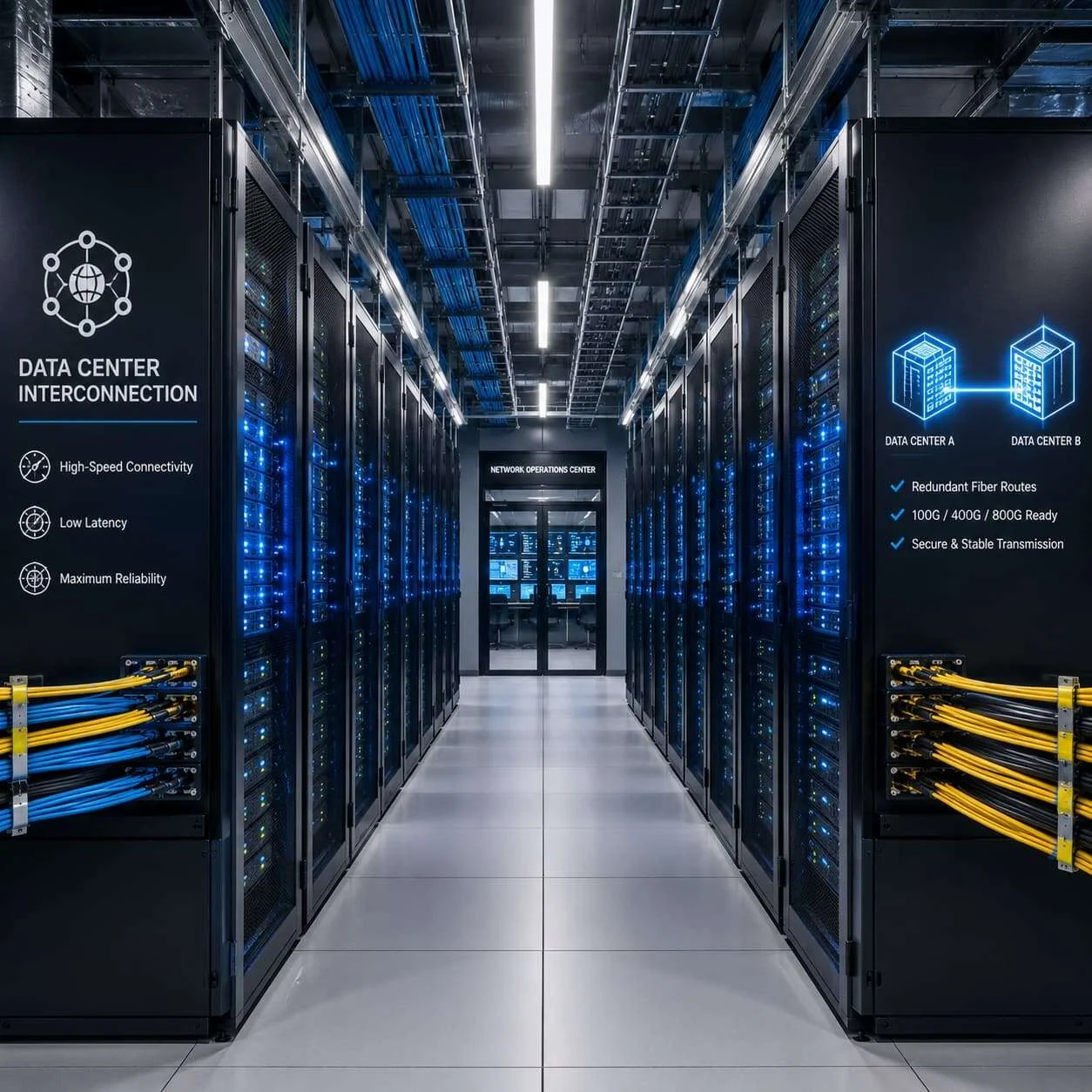
A typical security fiber network connects IP cameras and security sensors to local access switches, then to a distribution fiber network, aggregation switch, security control center, video management system and storage server or data center. In larger deployments, several regional surveillance nodes may connect to a central monitoring platform through a metropolitan or campus fiber backbone.
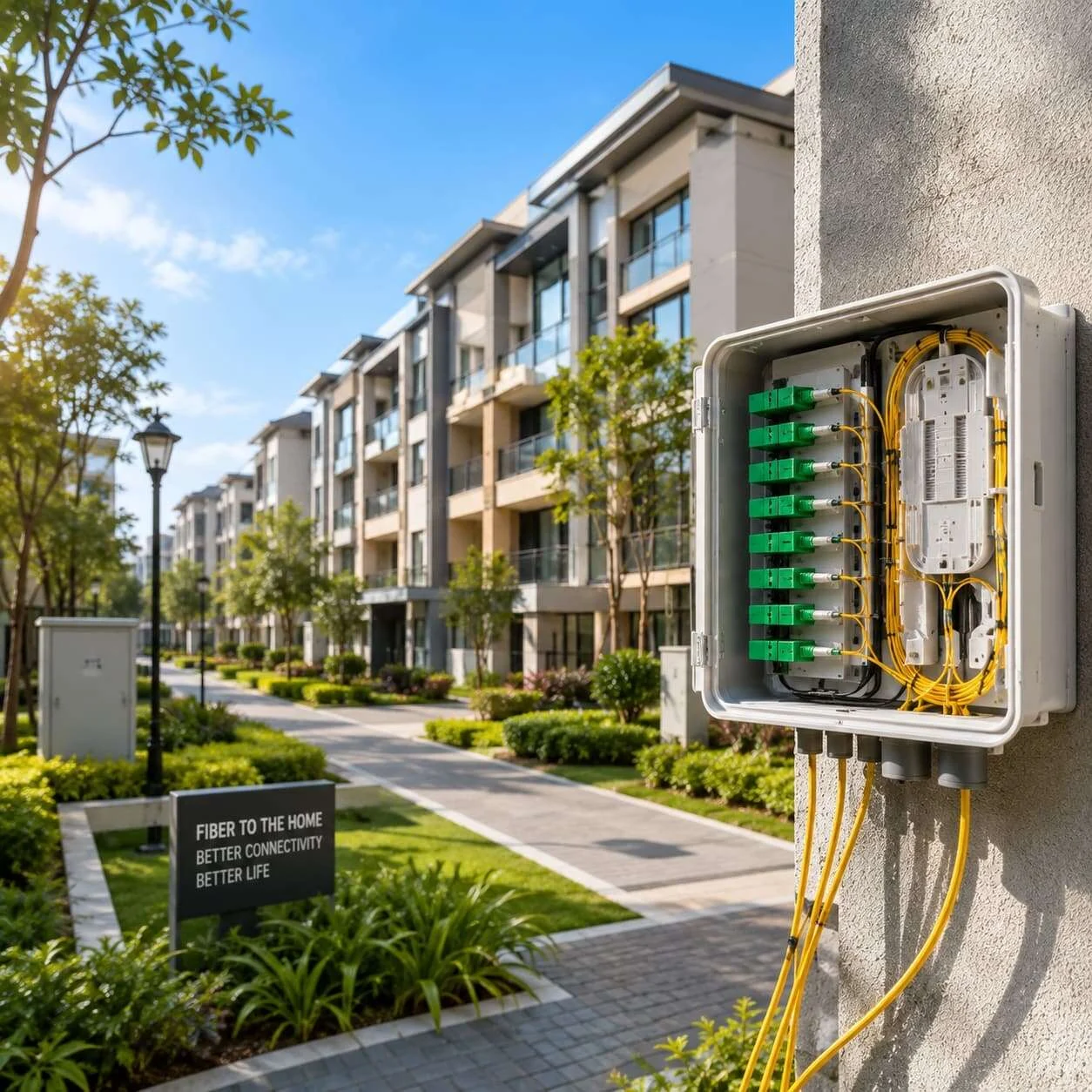
YITOFC CCTV and Security Network Solutions
1. City Surveillance Network
City surveillance systems connect cameras installed along roads, public areas, parks, transport stations and government facilities. These networks require long-distance transmission, large network coverage, high availability, outdoor environmental protection and scalable fiber capacity.
- Public security monitoring
- Street surveillance
- Municipal safety networks
- Public squares and parks
- Government buildings
- Emergency command systems
2. Traffic Monitoring and Intelligent Transportation
Modern transportation networks use cameras, sensors and control systems to monitor traffic conditions and improve road safety. Fiber networks may connect traffic cameras, traffic-light controllers, electronic toll systems, variable message signs, license plate recognition cameras and highway control centers.
3. Industrial Security Network
Factories, mines, energy facilities, warehouses and industrial parks often contain electrical equipment and harsh operating environments. Fiber optic cables are suitable because they resist electromagnetic interference and can support long transmission distances.
- Factory perimeter surveillance
- Production-line monitoring
- Warehouse security
- Oil and gas facilities
- Mining communication
- Power stations
- Chemical plants
- Industrial access control
4. Commercial Building Security
Office buildings, hotels, shopping centers and mixed-use developments require integrated security systems. Indoor IP cameras, parking surveillance, elevator monitoring, access control, fire alarm communication and building management systems can be connected through indoor and outdoor-to-indoor fiber cabling.
5. Campus and School Surveillance
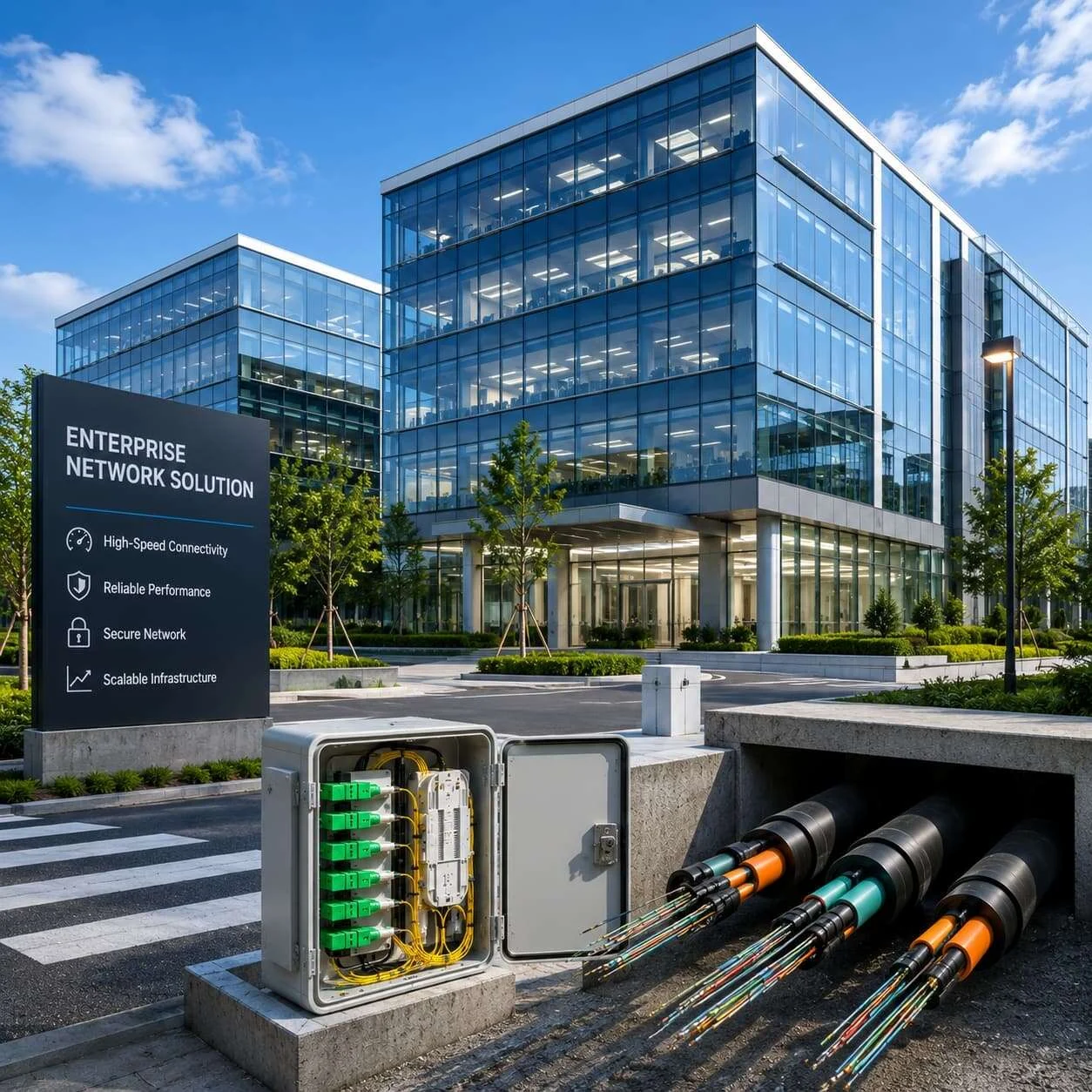
Schools, universities, hospitals and large campuses often contain multiple buildings across a wide area. Outdoor backbone cables connect buildings, while indoor distribution cables serve classrooms, dormitories, gates, parking areas, sports facilities, security centers and data rooms.
6. Airport, Railway and Transport Security
Transport hubs require reliable monitoring systems that operate continuously. Cable selection should consider vibration, moisture, installation route, fire-performance requirements and maintenance access.
7. Perimeter Security and Remote Monitoring
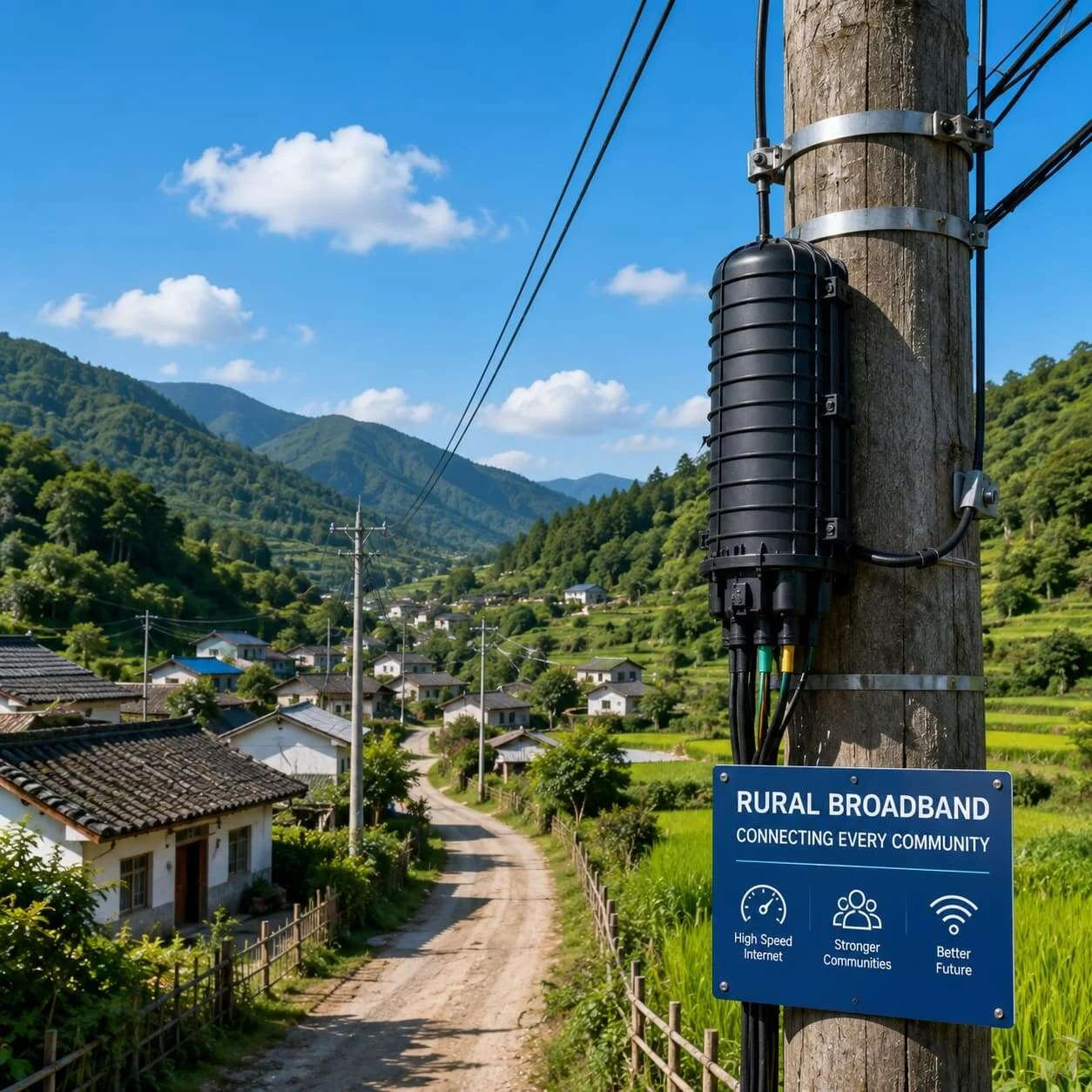
Perimeter security systems may combine cameras, intrusion sensors, access-control devices and alarm systems. Remote monitoring sites along highways, pipelines, power routes, borders, mountains or rural areas need strong environmental resistance, low maintenance and reliable connection to central control rooms.
Recommended Fiber Optic Cables for CCTV Networks
| Application | Recommended Cable | Typical Installation |
|---|---|---|
| City surveillance backbone | GYTS, GYTA | Underground duct |
| Traffic-monitoring network | GYTS, GYXTW | Roadside duct or local distribution |
| Direct-buried security route | GYTA53 | Direct burial |
| Aerial camera network | ADSS, Figure-8 | Pole-to-pole installation |
| Industrial environment | GYFTY, GYTS | Non-metallic or armored routes |
| Commercial building | Indoor fiber cable | Building riser and horizontal cabling |
| Campus surveillance | GYTS, GYXTW, indoor cable | Outdoor backbone and indoor distribution |
| Remote monitoring | ADSS, ASU, GYTA53 | Aerial or buried long-distance route |
GYXTW Fiber Optic Cable for Broadband Distribution
GYXTW is suitable for local distribution, roadside duct routes, building access and outdoor security routes where a compact armored cable structure is required.
GYTS Fiber Optic Cable for ISP Backbone Network
GYTS armored cable is commonly selected for outdoor backbone, metro security network and industrial surveillance routes that require stronger mechanical protection.
GYTA Fiber Optic Cable for Underground Duct Installation
GYTA cable can be considered for underground duct routes, road-side security networks, city surveillance backbones and campus distribution networks.
ADSS Aerial Fiber Optic Cable for Pole Routes
ADSS all-dielectric self-supporting cable is suitable for aerial routes where electrical isolation, pole-to-pole installation and long-span deployment are important.
How to Select Fiber Cable for a CCTV Project
Installation Environment
First confirm whether the cable will be installed in an underground duct, directly buried, on poles, along fences or walls, inside buildings, in tunnels, near electrical equipment or between separate buildings. The installation method directly affects the required cable structure.
Transmission Distance
Fiber optic cabling is more suitable than copper Ethernet for long roads, large industrial areas, campus networks, multi-building systems, remote camera sites and city-wide surveillance networks. The optical link design should consider cable distance, active equipment, connector loss and splice loss.
Fiber Count and Fiber Type
Common fiber counts include 2, 4, 6, 8, 12, 24 and 48 fibers. A small local camera network may require only a few fibers, while a city or campus backbone should include spare fibers for redundancy and future expansion. G.652.D is commonly used in outdoor long-distance networks, while G.657 fiber is useful where tighter bending performance is required.
Cable Protection and Redundancy
Depending on the environment, the cable may require steel tape armor, aluminum tape, steel-wire armor, non-metallic strength members, water-blocking materials, UV-resistant PE jacket, rodent-resistant design or flame-retardant indoor jacket. Mission-critical surveillance networks should consider ring topology, dual fiber routes, spare fibers and backup network equipment.
Network Topology Options
- Point-to-point links for remote gates, highway cameras, isolated buildings and critical monitoring points
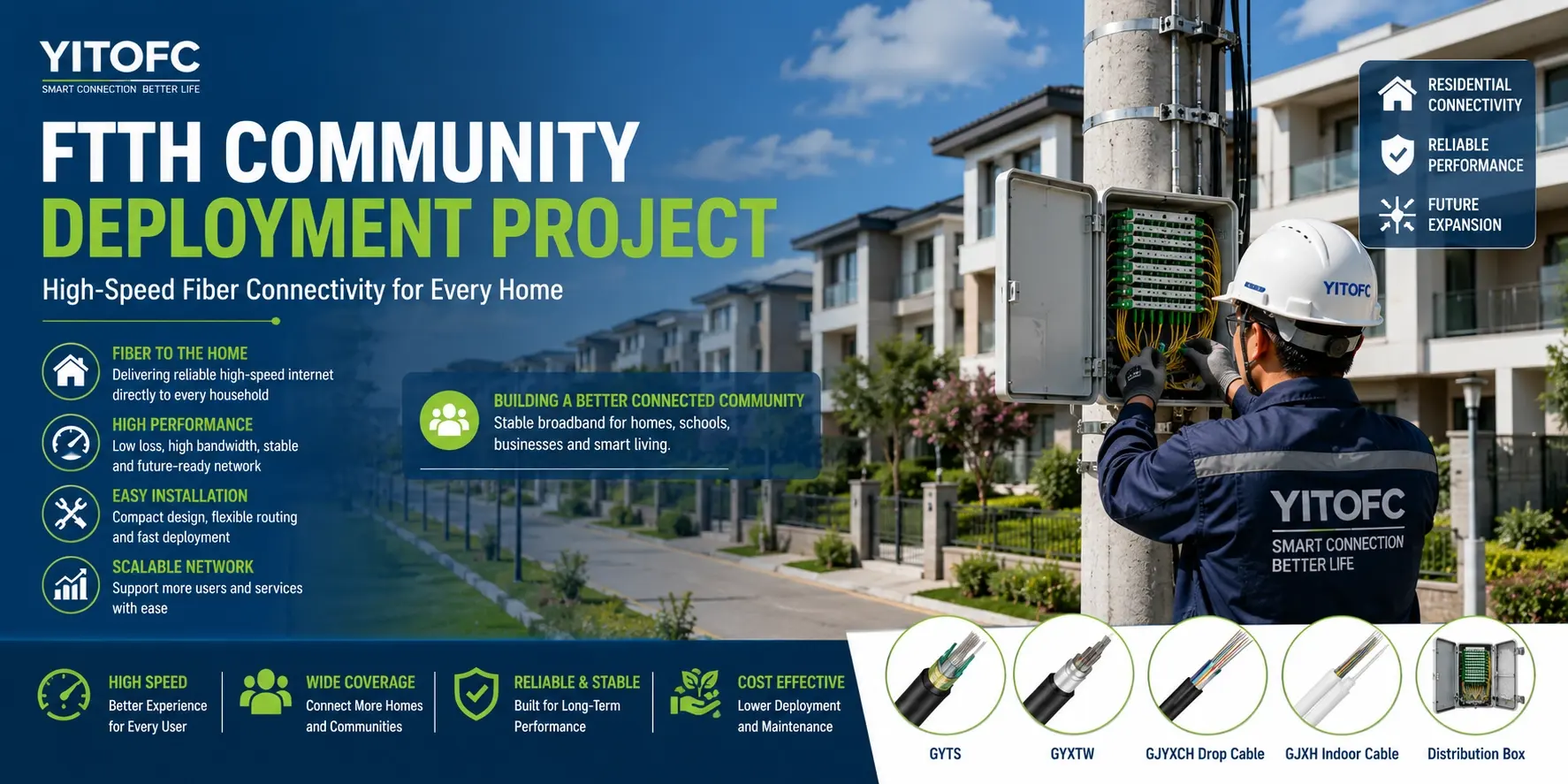
- Star topology for commercial buildings, residential communities, small campuses and warehouses
- Ring topology for city surveillance, industrial parks, airports, railways and mission-critical security networks
- Hybrid topology to balance cost, reliability and network coverage in large surveillance projects
Fiber Optic Cabling Components
A complete CCTV fiber network may include outdoor fiber optic cable, indoor fiber optic cable, fiber distribution box, optical distribution frame, fiber splice closure, patch panel, fiber patch cord, pigtail, optical transceiver, industrial Ethernet switch, media converter, camera cabinet, network video recorder and central storage server. YITOFC mainly supports fiber optic cable supply and can coordinate cable specifications with the project network architecture.
Benefits of YITOFC CCTV Fiber Solutions
- Long-distance transmission over routes where copper cabling is not practical
- High bandwidth for multiple high-resolution video streams and future camera upgrades
- Electromagnetic immunity in factories, power facilities and industrial environments
- Improved transmission security for security-sensitive networks
- Flexible deployment for duct, direct burial, aerial and indoor installation
- Future expansion through spare fibers and scalable cable design
Quality Control and Testing
YITOFC applies inspection and testing throughout production. Available tests may include fiber attenuation test, OTDR test, cable diameter inspection, jacket-thickness inspection, tensile test, crush test, impact test, repeated bending test, water penetration test, temperature cycling test, visual inspection and cable-length verification.
OEM and Customization Services
YITOFC provides customization options for security and surveillance projects, including fiber count, fiber type, cable structure, armor type, strength-member material, jacket material, jacket color, meter marking, customer logo, cable model printing, length per drum, wooden drum dimensions, export packaging and private-label manufacturing.
Information Required for a Quotation
- CCTV application or project type
- Installation method
- Fiber count and fiber type
- Required quantity
- Length per drum
- Outdoor or indoor environment
- Armor requirements
- Aerial span when applicable
- Destination country or port
Frequently Asked Questions
Why is fiber optic cable used for CCTV systems?
Fiber optic cable supports long-distance, high-bandwidth transmission and is resistant to electromagnetic interference. It is suitable for large or distributed surveillance systems.
Which fiber cable is suitable for outdoor CCTV cameras?
GYXTW, GYTS, GYTA, ADSS and Figure-8 cables may be used depending on whether the route is installed in a duct, buried underground or mounted on poles.
Can CCTV video be transmitted over several kilometers?
Yes. Fiber optic networks can support long-distance video transmission. The final link distance depends on optical transceivers, fiber type, connectors, splices and network design.
Can YITOFC customize cable printing?
Yes. Cable marking can include the customer brand, model, fiber count, meter marking and other agreed information.
Build a Reliable Security Network with YITOFC
Whether you are planning a city surveillance system, industrial security network, traffic-monitoring project or multi-building CCTV deployment, YITOFC can provide suitable fiber optic cable options for different installation environments. Contact our team to receive a cable recommendation, technical datasheet and quotation.